








Originally published March 19, 2020. Updated August 25, 2026.
For decades, lead-acid batteries were the default power source for material handling equipment. Lithium-ion has since become the standard for fleets that run multiple shifts because it changes the math on uptime, labor, and total cost of ownership—not just battery chemistry.
For a fleet manager, battery life isn't an abstract spec. It determines how many batteries you need to buy, how much labor goes into battery changes, and how much of your shift is actually productive. Here's how lithium-ion batteries and lead-acid batteries compare on the factors that matter most.
Lithium-Ion vs. Lead-Acid Battery Usage Times
Lithium-Ion Batteries
Lithium-ion batteries charge fast and have no memory effect, so partial (“opportunity”) charging is not just possible—it’s the recommended way to operate. A typical cycle looks like 8 hours of use, 1–2 hours to charge, and back to work, with no cool-down period required.
That makes continuous use across a 24-hour, multi-shift operation realistic, with charging happening during breaks, lunch, or shift changes rather than as a dedicated downtime block.
One caveat worth flagging: lithium-ion batteries should be kept above roughly 20% state of charge. Running them down to zero repeatedly triggers protective circuitry and, over time, can allow dendrite formation that shortens battery life. This isn't a deal breaker; it's a maintenance habit, not a limitation.
Lead-Acid Batteries
Lead-acid batteries generate significant heat during charging and require a cool-down period afterward. A standard cycle is 8 hours of use, 8 hours of charging, and 8 hours of rest.
This means one battery supports exactly one shift. Multi-shift operations need a battery swap for every shift, which results in buying and maintaining 2–3 batteries per piece of equipment instead of one.
| Comparison | Lead-Acid Battery | Lithium-Ion Battery |
|---|---|---|
| Charging Time | 8 hours | 1–2 hours |
| Cool-Down Period | 8 hours | Not needed |
| Charging Method | Removed from equipment and taken to a dedicated charging room | Opportunity-charged in place; no removal required |
| Safe Discharge | Down to 30–50% capacity | Down to 20% capacity |
| Opportunity Charging | No | Yes |
| Batteries Needed per Multi-Shift Unit | 2–3 | 1 |
Lead-acid batteries also require a ventilated charging area to manage off-gassing, plus the labor of transporting batteries to and from that room—time that doesn't show up on a spec sheet but does show up in a shift report.
Lithium-Ion vs. Lead-Acid Battery Lifespan
Lithium-Ion Battery Lifespan
Most manufacturers rate lithium-ion batteries for a minimum of roughly 2,000 charge cycles, with well-maintained packs reaching 3,000+ cycles depending on chemistry, usage pattern, and environment.
Lithium iron phosphate (LFP), the chemistry Flux Power uses, is favored for industrial applications specifically because it holds up better under heavy cycling and heat than other lithium chemistries.
Lead-Acid Battery Lifespan
Lead-acid batteries are typically rated for 1,000–1,500 cycles under proper maintenance conditions. In practice, that figure often comes in lower because lead-acid performance is more sensitive to heat, watering schedules, and maintenance discipline—and maintenance gaps are common in busy operations.
The gap between the two isn't just cycle count on paper. It's what happens when real-world maintenance isn't perfect, which is most of the time.
For a deeper look at battery longevity, read how many years a forklift battery lasts.
What Actually Shortens Battery Life?
Lithium-Ion Batteries
- Temperature extremes: LFP chemistry is comparatively resilient to heat and cold. Flux Power offers battery heaters for cold-storage and freezer applications to protect lifespan in sub-freezing environments.
- Storage: For extended idle periods, lithium-ion batteries should be stored at roughly 40–50% state of charge in a cool location, with a top-up check every couple of months.
- Deep cycling: Unlike lead-acid, partial charges are good for lithium-ion—they reduce stress on the cells rather than causing memory-related capacity loss.
Lead-Acid Batteries
- Temperature extremes: Heat during charging is inherent to the chemistry, which is why the cool-down period exists in the first place.
- Water levels: Watering has to be checked and maintained. Overfilling causes electrolyte loss and can accelerate corrosion, which leads to uneven charging.
- Deep discharge: Leaving a lead-acid battery in a discharged state for an extended period causes lasting capacity loss.
Why Battery Life Matters for Multi-Shift Operations
The clearest real-world case for lithium-ion is a facility that can't afford downtime. A major Midwest manufacturing facility runs well over 125 Flux Power batteries across a 2M+ sq. ft., three-shift operation—a deployment now in its seventh year.
That's the kind of environment where cycle life, opportunity charging, and eliminating battery swaps translate directly into fewer forklifts sitting idle and less labor spent moving batteries around instead of product.
Which Lasts Longer: Lithium-Ion or Lead-Acid Batteries?
Lithium-ion's real advantage isn't just a longer cycle life on a spec sheet. It's that one battery can cover multiple shifts without a swap, while lead-acid needs a battery per shift, per vehicle.
For a fleet running two or three shifts, that difference compounds fast: fewer batteries to buy, less charging infrastructure to build out, and less labor spent on battery handling instead of material handling.
Frequently Asked Questions About Lithium-Ion vs. Lead-Acid Batteries
How does the lifespan of lithium-ion batteries compare to lead-acid batteries?
Lithium-ion batteries typically run 2,000–3,000+ charge cycles, versus roughly 1,000–1,500 for lead-acid under proper maintenance. This means lithium-ion generally delivers close to double the usable life, and often more in real-world multi-shift use.
What's the difference in charging time?
Lithium-ion batteries fully charge in 1–2 hours and support opportunity charging throughout a shift. Lead-acid batteries need about 8 hours to charge plus a mandatory cool-down period, making them unavailable for roughly 16 hours per cycle.
How does lithium-ion battery maintenance differ from lead-acid?
Lithium-ion batteries require no watering or equalizing charges. Lead-acid batteries need regular water-level checks and equalization to avoid premature failure.
Can lithium-ion batteries be opportunity-charged without hurting their lifespan?
Yes. Partial charging during breaks or shift changes is standard practice for lithium-ion and doesn't shorten cycle life. Lead-acid batteries, by contrast, degrade faster with partial or incomplete charging.
What safety advantages does lithium-ion have over lead-acid?
Lithium-ion eliminates the acid-spill and off-gassing risks associated with lead-acid charging and handling. Flux Power's batteries are UL 2271 and UL 2580 certified, and Flux Power is ISO 9001:2015 certified.
How do Flux Power batteries fit into a broader efficiency strategy?
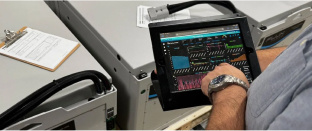
Beyond battery chemistry, Flux Power's SkyEMS fleet energy management platform gives operations real-time visibility into battery health and utilization, helping fleets get more out of every charge cycle.
To learn more about how Flux Power can help optimize your fleet, talk to one of our Energy Experts.