









To size a lithium-ion forklift battery, match the truck's required voltage and minimum weight first, then pick the capacity (amp-hours) that covers the energy your truck uses between charging opportunities, with a buffer for depth of discharge and battery aging. Your duty cycle, not the size of the old lead-acid battery, should drive that capacity decision.
Many fleets simply replace a lead-acid battery with a lithium-ion pack of the same amp-hour rating. That often works, but it can leave money on the table. Lithium-ion packs can be opportunity charged during breaks, which changes the math entirely. A right-sized pack can run multiple shifts without a battery swap, while an oversized one adds cost you never use.
This guide walks fleet managers through a five-step sizing method, a worked example, and how each Flux Power product line fits common duty cycles.
What Is a Forklift Duty Cycle?
A forklift duty cycle is the pattern of work a truck does over a shift: how many hours it runs, how hard it works during those hours, and when it sits idle. Two trucks of the same model can have very different duty cycles.
The factors that shape energy use include:
- Run time: hours of active operation per shift and shifts per day
- Load and lift profile: load weights, lift heights, and lifts per hour
- Travel: distance traveled, ramps, and dock plate crossings
- Environment: cold storage and freezers increase energy draw and affect charging
- Idle windows: breaks, lunches, and shift changes where charging can happen
Why Duty Cycle Matters More Than Amp-Hours Alone
Lead-acid batteries are typically sized to survive one full shift, then swapped or charged for about eight hours plus cooling time. That forces fleets to buy spare batteries and dedicate floor space to battery rooms.
Lithium-ion changes the model. Because lithium-ion packs accept partial charges without damage, capacity only needs to cover the energy used between charges, not an entire day. As covered in our guide to lithium-ion charging best practices, short, frequent charges support battery health rather than degrade it.
That means the right answer depends on two linked decisions: battery capacity and charging strategy.
How to Size a Lithium-Ion Forklift Battery in 5 Steps
Step 1: Confirm Truck Class, Voltage, and Weight
Start with the truck, not the battery. Check the data plate and OEM spec sheet for:
- System voltage (24V, 36V, 48V, or 80V)
- Battery compartment dimensions
- Minimum battery weight, since the battery acts as counterweight on many trucks
- Connector type and cable position
Voltage is not negotiable. Weight matters too: Flux Power packs offer truck adapters to meet OEM weight requirements, so a lithium-ion pack can stand in for a heavier lead-acid battery without affecting stability.
Step 2: Measure Energy Use per Hour
Next, determine how much energy each truck consumes, in kilowatt-hours (kWh) per operating hour. Good data sources include:
- Battery telematics from an existing lithium-ion pilot or a SkyEMS fleet dashboard
- Discharge data from current lead-acid batteries and chargers
- OEM energy-consumption ratings for the truck model
- A short trial using a Flux Power demo battery
Measure your heaviest-working trucks, not the fleet average. Sizing to the average leaves your busiest trucks short at the end of a shift.
Step 3: Map Your Charging Windows
List every point in the day where a truck could plug in: scheduled breaks, lunches, shift changes, and natural idle periods. Note how long each window lasts and whether a charger is nearby.
The longest stretch between charging windows sets your minimum capacity. A truck that charges every two hours needs far less capacity than one that must run a full eight-hour shift untouched.
Step 4: Calculate Forklift Battery Capacity (kWh and Ah)
Use this formula to estimate the usable energy a pack needs:
Required kWh = (kWh per hour × hours between charges − kWh recovered during charging) ÷ usable depth of discharge × (1 + aging margin)
Then convert to amp-hours: Ah = (Required kWh × 1,000) ÷ system voltage
Planning guidelines:
- Depth of discharge: plan around 80%. Flux Power packs are rated for over 3,500 cycles at 80% depth of discharge.
- Aging margin: add 10–20% so the pack still covers the shift late in its service life.
- Cold environments: add further margin for freezer and cold storage applications, and consider packs with integrated heaters.
Step 5: Match Charger Output to the Plan
Capacity and charger output work together. A charger's power (kW) multiplied by the charge window (hours) tells you how much energy you can put back. If your plan relies on 30 minutes of charging at lunch, confirm the charger can actually deliver that energy in 30 minutes. Our forklift battery charger guide covers charger types and infrastructure considerations.
Worked Example: A 48V Counterbalance Forklift on Three Shifts
Illustrative numbers only. Actual consumption varies by truck, load, and application. Talk to your Flux Power Energy Expert for a full fleet assessment.
A distribution center runs 48V Class I counterbalance forklifts across three eight-hour shifts. Telematics show the busiest trucks use about 4 kWh per operating hour and run about 7.5 hours per shift.
|
Scenario |
Energy per shift |
Recovered by charging |
Required capacity |
Pack fit |
|
No charging during shift |
30 kWh |
0 kWh |
30 ÷ 0.8 × 1.2 = 45 kWh (≈940 Ah at 48V) |
Needs a swap or oversized pack |
|
Opportunity charging at breaks and lunch (~1 hour total at ~8 kWh/hr) |
30 kWh |
~8 kWh |
22 ÷ 0.8 × 1.2 = 33 kWh (≈690 Ah at 48V) |
48V, 840 Ah (≈40 kWh) with headroom |
With opportunity charging, a single 48V, 840 Ah pack covers each shift with room to spare, and the truck recharges between shifts. No spare batteries, no battery room, no swaps. A 630 Ah pack (≈30 kWh) would fall just short for these busiest trucks, but could suit lighter-duty trucks in the same fleet.
That last point matters: in a mixed fleet, sizing truck by truck usually beats a one-size-fits-all purchase.
Which Flux Power Battery Fits Your Duty Cycle?
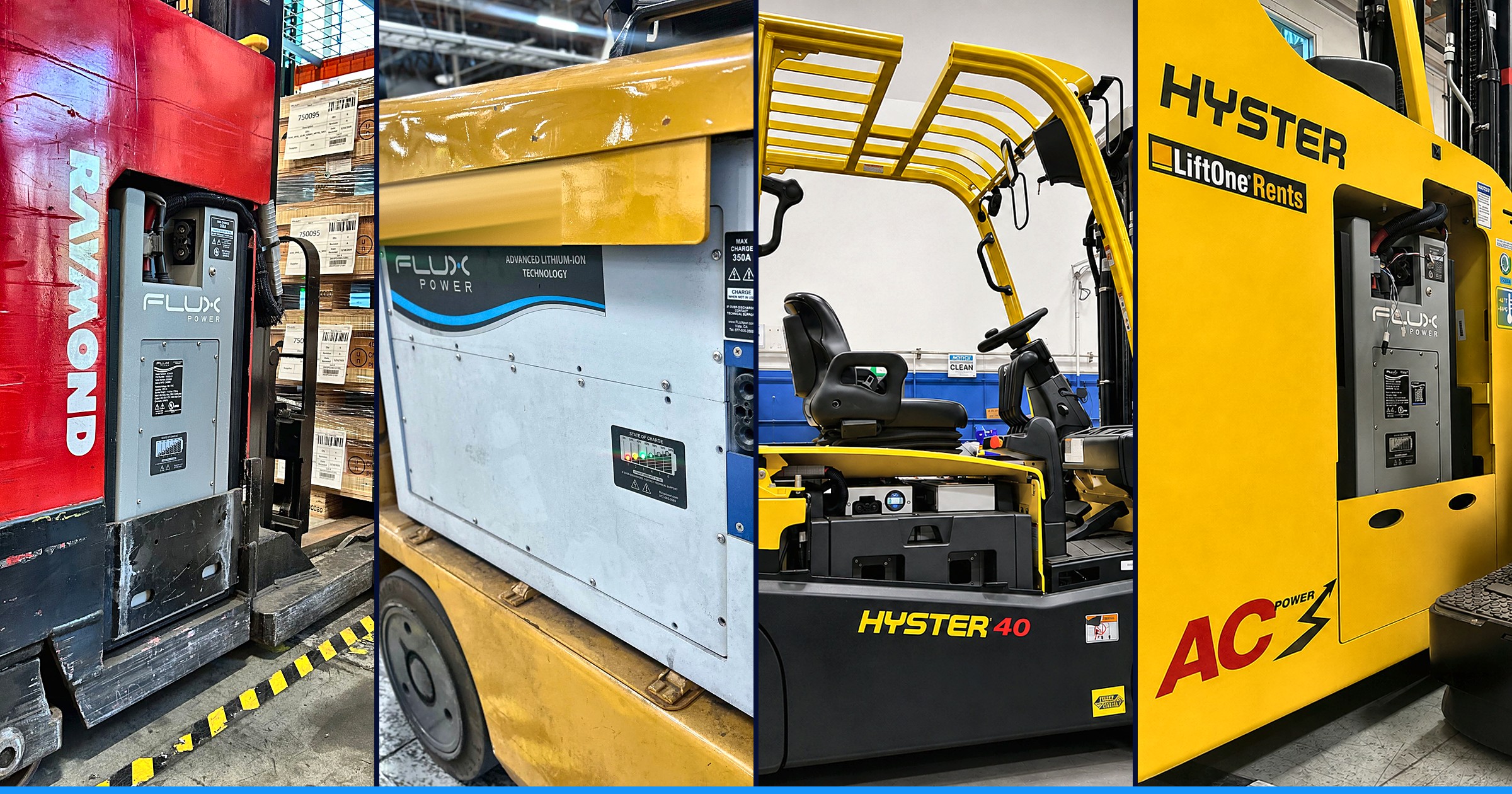
Flux Power builds lithium-iron battery packs for Class I, II, and III electric forklifts. Each series is designed for a specific truck type and its typical work pattern.
|
Series |
Equipment |
Voltage |
Capacity options |
Typical duty cycle |
|
Class I counterbalance forklifts |
36V, 48V, 80V |
Up to 840 Ah |
Heavy loads, dock work, high-intensity multi-shift |
|
|
Class I 3-wheel counterbalance forklifts |
36V (L36), 48V (L48) |
L36: 630 or 840 Ah |
Tight-turning, high-throughput warehouse aisles |
|
|
Class II narrow aisle (M36); Class III end and center riders (M24) |
36V, 24V |
M36: 630 or 840 Ah; M24: 420 Ah |
Order picking, reach work, frequent stop-and-go |
|
|
Class III walkie pallet jacks |
24V |
S24: 105 or 210 Ah |
Intermittent, light-to-moderate use; UL Type EE options available |
A few selection tips:
- X-Series suits the hardest-working trucks in the building, where high, sustained power and multi-shift operation matter most.
- L-Series brings the same multi-shift advantages to 3-wheel trucks, with higher-capacity L36 options for demanding shifts.
- M-Series covers narrow aisle and rider equipment, and the M24 offers an onboard charger option so operators can plug into a standard outlet instead of returning to a charging station.
- S-Series fits walkie pallet jacks; the 210 Ah S24 covers extra-long or demanding shifts, and UL Type EE versions serve sites with stricter requirements.
Explore how these packs fit specific operations on our industries page.
Use Data to Keep Your Sizing Right Over Time
Duty cycles change. Volume grows, shifts get added, and trucks get reassigned. A battery that was right-sized at deployment can become undersized two years later.
Fleet energy management software closes that gap. SkyEMS tracks state of charge, utilization, charging behavior, and battery health across every connected pack. That data shows which trucks run close to empty, which are underused, and when to rebalance the fleet. Learn more in How Smart Battery Data Helps Manage Forklift Fleets More Efficiently and Intelligent Fleet Power.
Common Battery Sizing Mistakes to Avoid
- Copying the lead-acid amp-hour rating without accounting for opportunity charging
- Sizing to the fleet average instead of the busiest trucks
- Ignoring cold storage, which raises energy use and limits charging rates
- Planning charge windows without matching charger output
- Skipping a pilot before a full fleet conversion
Get Help Sizing Your Fleet
The fastest way to right-size a lithium-ion forklift battery is to test it in your own operation. Flux Power's demo battery program lets you trial a pack on your trucks and duty cycles before committing to a fleet conversion.
Talk to a Flux Power energy expert to review your duty cycle, charging windows, and the X, L, M, or S Series pack that fits each truck.
Frequently Asked Questions About Forklift Battery Sizing
How do I know what size lithium-ion forklift battery I need?
Start with the truck's required voltage and minimum battery weight. Then measure energy use per operating hour, map your charging windows, and calculate the capacity needed to cover the longest stretch between charges at about 80% depth of discharge, plus a 10–20% aging margin.
Can I use the same amp-hour rating as my lead-acid battery?
You can, but it may not be the best fit. Lead-acid batteries are sized to last a full shift without charging. Lithium-ion packs can be opportunity charged during breaks, so the right capacity depends on your charging windows and duty cycle, not the old battery's rating.
What is a duty cycle for a forklift?
A forklift duty cycle is the pattern of work a truck performs over a shift, including run hours, load weights, lift heights, travel distance, operating environment, and idle time. It determines how much energy the truck uses and when it can recharge.
How does opportunity charging affect battery sizing?
Opportunity charging lets lithium-ion packs recover energy during breaks, lunches, and shift changes. Because energy is added back throughout the day, the battery only needs to cover the work done between charges. That often allows one pack per truck across multiple shifts, with no battery swaps.
Does cold storage change how I size a forklift battery?
Yes. Cold and freezer environments increase energy consumption and can limit charging rates. Add extra capacity margin for cold storage duty cycles and consider battery packs with integrated heaters that are designed for low-temperature operation.
Which Flux Power battery fits my forklift?
X-Series fits Class I counterbalance forklifts at 36V, 48V, or 80V. L-Series fits Class I 3-wheel forklifts. M-Series covers Class II narrow aisle (M36) and Class III end and center riders (M24). S-Series fits Class III walkie pallet jacks.
How long does a lithium-ion forklift battery last?
Service life depends on duty cycle and charging habits. Flux Power lithium-ion packs are rated for more than 3,500 cycles at 80% depth of discharge. Sizing the pack correctly and following charging best practices helps it reach that rating.
Can I test a lithium-ion battery before converting my fleet?
Yes. Flux Power's demo battery program lets fleets trial a lithium-ion pack on their own trucks and duty cycles. It is the most reliable way to confirm sizing before a full fleet conversion.