







If you've compared battery spec sheets for your material handling fleet, you've seen the term "energy density" tossed around like it's self-explanatory. It isn't. And the fleet managers who understand what it actually measures and what it doesn't make better purchasing decisions than the ones who just compare price-per-battery.
Here's the plain-language version, and why it matters more for lithium-ion than it ever did for lead-acid.
What Energy Density Actually Means
Energy density is a measure of how much energy a battery can store relative to its size or weight. It's typically expressed two ways:
- Gravimetric energy density (Wh/kg) — energy stored per unit of weight
- Volumetric energy density (Wh/L) — energy stored per unit of volume
Both matter for forklifts, but for different reasons. Gravimetric density affects truck balance, counterweight requirements, and how much of your vehicle's rated capacity goes toward payload versus battery mass. Volumetric density affects how much battery you can physically fit into a compartment designed decades ago around lead-acid dimensions.
Lithium-ion chemistries generally deliver notably higher energy density than flooded lead-acid on both counts — one of the core engineering reasons the material handling industry has been converting fleets, not just a marketing talking point.
Why This Isn't Just a Spec Sheet Number
Energy density translates directly into three things a fleet manager actually cares about:
1. Runtime per charge. Higher energy density means more usable energy packed into the same physical footprint, which supports longer run times without swapping batteries mid-shift, critical for multi-shift operations that can't afford a battery-change window.
2. Fleet footprint and flexibility. A denser battery can fit into compartments originally sized for lead-acid, meaning a lithium-ion retrofit doesn't necessarily require a new truck. This is a common misconception worth correcting: chemistry conversion and vehicle replacement are separate decisions.
3. Total weight budget. Every pound of battery is a pound not available for payload or counterbalance in the original engineering spec. Energy-dense batteries let engineers hit required runtime targets without over-weighting the truck.
Where Energy Density Claims Get Oversold
This is where fleet managers should apply healthy skepticism, and where credible vendors should welcome the scrutiny. A few things energy density does not tell you on its own:
- It doesn't account for usable capacity across the discharge curve — some chemistries advertise peak density but sag under sustained load.
- It doesn't reflect cycle life or degradation curve — a dense battery that fades fast at year three isn't necessarily the better total-cost-of-ownership choice.
- It says nothing about thermal management or safety margin — packing more energy into less space raises the bar for battery management system (BMS) design, not just cell chemistry.
Any energy density figure should be read alongside cycle life data, BMS specifications, and independent safety certification not in isolation. This is why UL 2271 (battery pack) and UL 2580 (electric vehicle battery) certifications matter as much as the energy density number itself: they validate that a dense pack is also a safe one.
Why This Matters More as Fleets Electrify Further
As more of the fleet converts from internal combustion or lead-acid to lithium-ion, energy density becomes a constraint on fleet design decisions that used to be simple. Facilities considering multi-shift electrification, cold storage operations, or high-density warehousing are increasingly running the math on:
- How many trucks can be supported on the current electrical infrastructure
- Whether existing compartments can accept a lithium-ion retrofit without truck replacement
- What runtime margin is needed to avoid mid-shift battery swaps
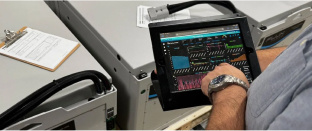
Energy density sits underneath all three questions. It's also part of why fleet energy management is increasingly software-assisted rather than spreadsheet-tracked — knowing a battery's rated energy density matters less than knowing its real-time state of health and how that's trending across a fleet of trucks over time.
The Practical Takeaway for Fleet Managers
When evaluating lithium-ion options, ask vendors for energy density figures alongside:
-
- Independent safety certification (UL 2271, UL 2580)
- Cycle life data at stated depth of discharge
- OEM certification for your specific truck models
- Real-world runtime data from comparable multi-shift operations, not lab conditions
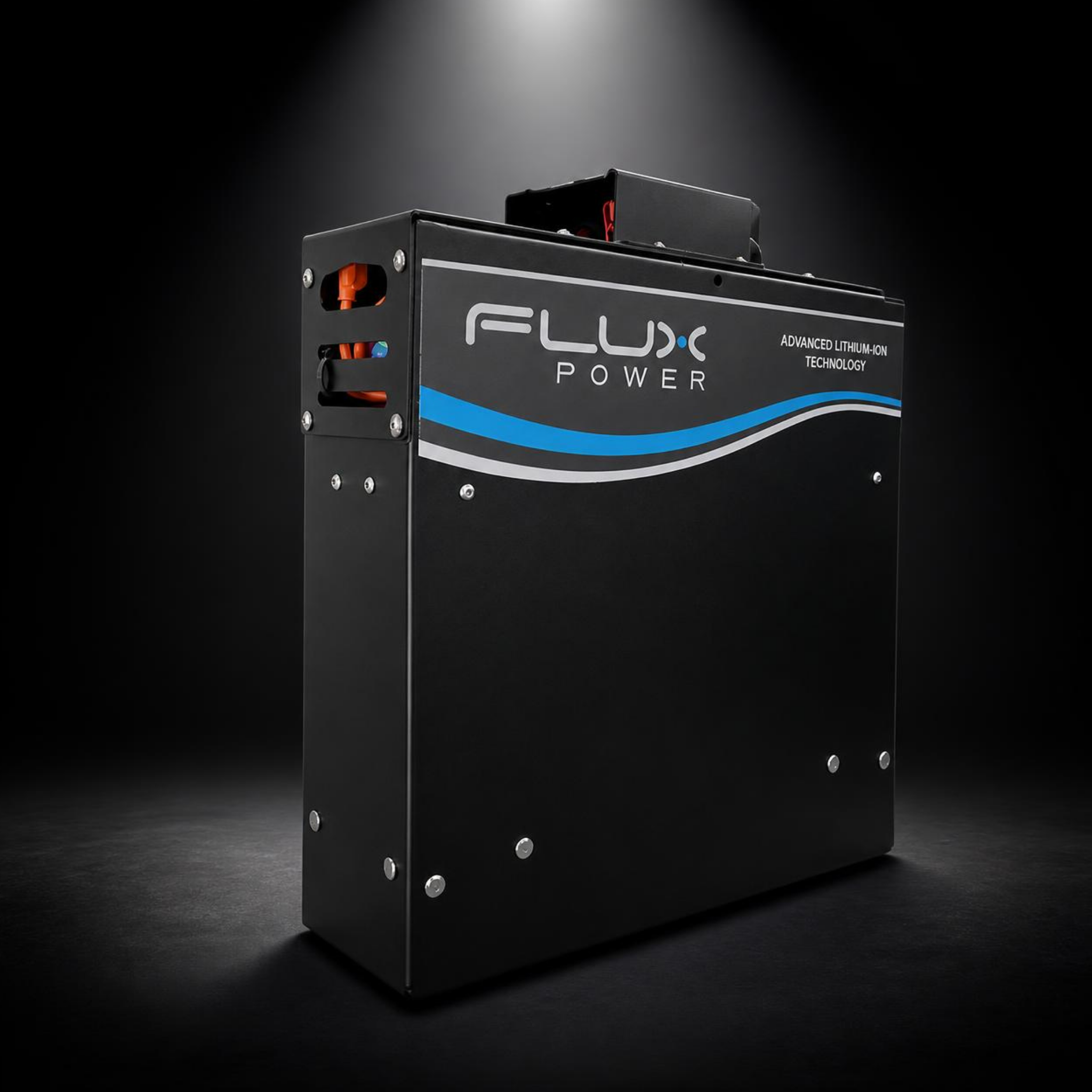
Flux Power designs lithium-ion battery systems for Class I, II, and III material handling equipment, certified to UL 2271 and UL 2580 in the U.S. and have multiple OEM certifications. Fleet-level visibility into state of health, charge cycles, and end-of-life forecasting is available through SkyEMS, Flux Power's fleet energy management platform.