





As more warehouses and distribution centers move toward automation, two acronyms come up constantly: AGV and AMR. They are often used interchangeably, but they are not the same technology, and they can have different power requirements. Understanding the difference matters not only when selecting automated equipment, but also when choosing the battery that keeps it running.
Whether you're evaluating automation for the first time or scaling an existing fleet, understanding how AGVs and AMRs navigate, where each technology fits, and what each demands from its power source can help you build a more reliable automation strategy.
AGV vs. AMR: Quick Answer
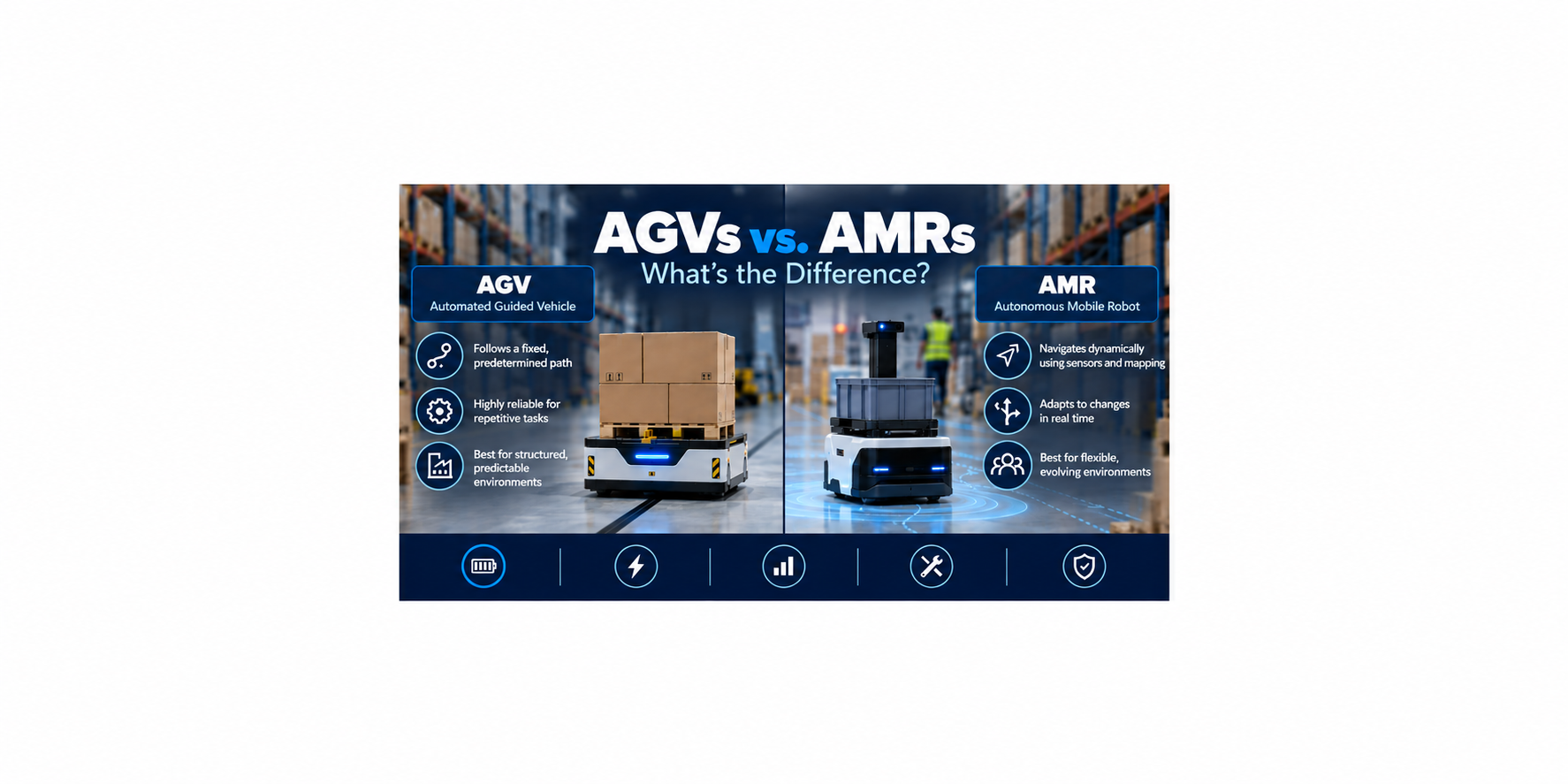
An AGV (Automated Guided Vehicle) generally follows a predetermined route using technologies such as magnetic strips, wires or reflective markers. An AMR (Autonomous Mobile Robot) uses sensors, cameras and mapping software to navigate dynamically and adapt to its surroundings. AGVs are generally suited to repetitive, predictable material movement, while AMRs are designed for more flexible environments. Both can benefit from lithium-ion batteries because opportunity charging, consistent power delivery and reduced maintenance can help support automated fleet uptime.
What Is an AGV (Automated Guided Vehicle)?
AGVs follow a fixed, predetermined path to move materials between set points in a facility. That path is typically defined by magnetic strips, embedded floor wires, reflective tape or other guidance methods, and the vehicle follows it precisely, trip after trip.
Because the route is predictable, AGVs are well suited to repetitive, high-volume tasks. Think of moving pallets from a receiving dock to a designated storage zone over and over on a consistent loop.
AGVs are best suited for:
- High-repetition routes that don't change often
- Predictable, structured environments
- Operations that prioritize consistency and throughput over flexibility
The tradeoff is infrastructure. If a route needs to change, the facility may need to modify the guidance infrastructure, which can make AGVs less adaptable to facilities that frequently reconfigure layouts.
What Is an AMR (Autonomous Mobile Robot)?
AMRs take a different approach. Instead of following a fixed path, they navigate dynamically using onboard sensors, cameras and mapping software, often relying on SLAM (simultaneous localization and mapping) to understand their environment in real time.
This means an AMR can reroute around an obstacle, adjust to a new shelving layout, or navigate a space that is constantly changing without requiring the facility to re-engineer a fixed floor guide.
AMRs are best suited for:
- Facilities with shifting layouts or frequent SKU changes
- Mixed environments where robots and human workers operate side by side
- Operations that need to scale automation without major infrastructure investment
The flexibility comes from software and sensors rather than fixed guides, which is one reason AMRs are commonly associated with fulfillment and e-commerce environments where conditions can change frequently.
AGV vs. AMR: What's the Difference?
|
Feature |
AGV |
AMR |
|
Navigation |
Fixed or predetermined path |
Dynamic navigation |
|
Guidance |
Wires, magnetic strips, tape or markers |
Sensors, cameras and mapping software |
|
Flexibility |
Lower; route changes may require infrastructure changes |
Higher; can adapt to changes in real time |
|
Environment |
Structured and predictable |
Dynamic or changing |
|
Route changes |
May require guidance-infrastructure changes |
Typically handled through software/navigation |
|
Best suited for |
Repetitive, high-volume material movement |
Flexible, evolving material movement |
|
Infrastructure |
More infrastructure-dependent |
More software-driven |
|
Battery considerations |
Opportunity charging, uptime and BMS |
Opportunity charging, uptime and BMS |
Neither technology is inherently better. They solve different problems. Many facilities can use AGVs for high-volume fixed routes and AMRs for tasks that require greater flexibility.
How to Choose Between an AGV and AMR
An AGV may be a fit when:
- Routes are predictable
- Material movement is repetitive
- The facility layout is relatively stable
- High-volume point-to-point movement is required
An AMR may be a fit when:
- Routes change frequently
- The environment is dynamic
- Human and robot interaction is common
- You need flexibility as operations evolve
Why Battery Choice Matters for AGVs and AMRs
Here's what AGVs and AMRs have in common, regardless of how they navigate: downtime can undermine automation ROI. A robot that isn't moving because it is waiting on a charge, swapping batteries, or losing performance mid-shift isn't delivering the full value expected from an automated operation.
A few power considerations matter for both vehicle types:
Opportunity charging
Lithium-ion batteries can allow AGVs and AMRs to top off during short pauses in a cycle, such as a break in the route or a queue at a charging dock rather than requiring a full charge or battery swap. For automated fleets designed for frequent operation, those short charging opportunities can add up across a shift.
Consistent power delivery
Lithium-ion batteries generally maintain a more consistent voltage profile throughout much of the discharge cycle than traditional lead-acid batteries. This can help an automated vehicle maintain predictable operation throughout its duty cycle.
Reduced maintenance downtime
Traditional lead-acid batteries can require watering, equalizing charges and acid handling. Reducing these manual maintenance requirements can be particularly relevant in automated operations, where minimizing human intervention is a central objective.
Battery management and safety
When a vehicle operates autonomously, there's no operator on board to notice a problem, so battery visibility becomes critical. A battery management system (BMS) that monitors voltage, temperature, and performance in real time fills that gap. When evaluating a battery for an automated vehicle, consider the chemistry, pack design, thermal management, and the specific OEM application. Flux Power takes fleet intelligence a step further by pairing its SkyBMS with SkyEMS, an AI-powered dashboard that gives you a clear view of every battery across your fleet.
Lithium-Ion Batteries for AGVs and AMRs
Flux Power develops lithium-ion battery solutions for material-handling and automated equipment, including AGV and AMR applications. Its battery systems are designed around the demands of automated operations, including opportunity charging, battery management, consistent power delivery and fleet uptime.
AGV vs. AMR FAQs
What is an AGV?
An AGV, or Automated Guided Vehicle, is a mobile vehicle that transports materials along a predetermined route within a facility.
What is an AMR?
An AMR, or Autonomous Mobile Robot, is a mobile robot that uses sensors, cameras and mapping technology to navigate dynamically within a facility.
What is the difference between an AGV and an AMR?
AGVs generally follow predetermined routes, while AMRs navigate dynamically and can adapt to changes in their environment.
Are lithium-ion batteries used in AGVs?
Yes. Lithium-ion batteries can power AGVs and support opportunity charging, consistent power delivery and reduced maintenance compared with traditional lead-acid batteries.
Are lithium-ion batteries used in AMRs?
Yes. Lithium-ion batteries can support AMRs that require frequent operation and opportunity charging.
Can AGVs and AMRs use the same type of battery?
Battery requirements depend on the vehicle, voltage, capacity, physical dimensions, duty cycle and OEM specifications. Battery selection should be matched to the specific automated vehicle and application.
Why is opportunity charging important for automated vehicles?
Opportunity charging can allow an automated vehicle to add energy during planned pauses rather than relying only on long charging periods or battery swaps, depending on the vehicle and charging system.
AGV vs. AMR: Choosing the Right Power Strategy
AGVs and AMRs solve different automation challenges, but both depend on reliable power to deliver the productivity gains automation is designed to achieve. Lithium-ion batteries can support automated fleets through opportunity charging, consistent power delivery, reduced maintenance and battery management capabilities.
Flux Power's lithium-ion battery solutions are built to support automated material-handling applications. Talk to an Energy Expert today to learn more.